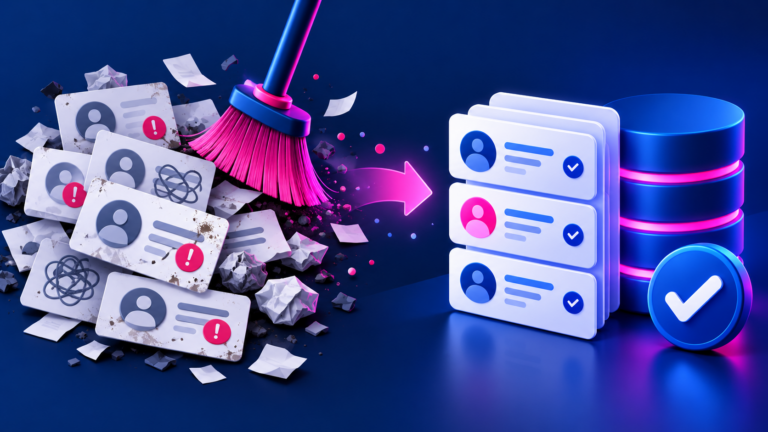

Connecting AI to a CRM can make work faster, but it also changes how personal information is collected, used, shared, and retained. Canadian businesses should ask these questions before sending customer records to a new tool. This article is general information, not legal advice; obligations vary by organisation, province, sector, and activity.
Know what data is moving
Map the fields, sources, purpose, destination, retention, access, and deletion path. Do not treat a CRM export as harmless simply because it is convenient.
- Minimise fields to what the use case requires.
- Classify sensitive and personal information.
- Document vendors, subprocessors, and access roles.
Check authority, notice, and control
The Office of the Privacy Commissioner of Canada highlights legal authority, meaningful consent where applicable, appropriate purposes, and responsible handling for generative AI. Ask how the provider uses prompts, records, and outputs, and how a business can correct or delete information.
- Confirm whether data is used for provider training.
- Set retention and deletion expectations.
- Keep a human review for consequential decisions.
Build privacy into the workflow
Digital Allo’s custom AI solutions and CRM workflows can be scoped around least-data principles, access controls, review, and clear ownership. Bring legal or privacy expertise into higher-risk projects before implementation.
- Write a data-flow diagram.
- Test with synthetic or minimised data first.
- Record incidents and an escalation route.
Which privacy law applies?
Most private-sector businesses in British Columbia are covered by BC’s Personal Information Protection Act (PIPA) for personal information they handle in the province. The federal Personal Information Protection and Electronic Documents Act (PIPEDA) generally applies to federally regulated businesses and to personal information that crosses provincial or national borders in commercial activity. Some businesses need to consider both. If you are unsure, ask a privacy professional.
Questions to ask an AI or CRM vendor
- Is our data used to train or improve your models? Can we turn that off?
- Where is data stored and processed, and which subprocessors are involved?
- How long are prompts, files and outputs kept, and can we delete them?
- Who at your company can access our data, and is that access logged?
- How will you notify us of a breach, and how quickly?
- Can we export our data if we leave?
- What security certifications or independent audits can you share?
A minimal data-flow record
| Field | Example entry |
|---|---|
| Data | Name, email, phone, enquiry text |
| Source | Website enquiry form |
| Purpose | Summarise enquiries and route them to the right person |
| Destination | CRM and AI summarisation service |
| Retention | Summaries kept with the CRM record; raw prompts deleted after 30 days |
| Access | Sales team and administrator |
| Owner | Operations manager |
The retention period in this example is illustrative. Set yours based on your purpose and obligations.
A practical starting point
- Map the data before choosing a tool.
- Ask direct vendor privacy questions.
- Use minimisation, access control, and review by design.
Frequently asked questions
Is Canadian hosting the only privacy question?
No. Location may matter, but purpose, authority, access, retention, security, vendors, and user rights also need review.
Can AI make decisions about customers?
High-impact or sensitive decisions require careful governance and may be inappropriate without specialist review.
Do we need to update our privacy policy?
If AI tools process personal information in new ways, your privacy policy and notices may need to explain the purpose, the types of service providers involved and how people can ask questions.
Further reading
- Office of the Privacy Commissioner of Canada: Principles for responsible generative AI
- Office of the Privacy Commissioner of Canada: PIPEDA overview
- BC Laws: Personal Information Protection Act
- Office of the Information and Privacy Commissioner for British Columbia
How Digital Allo can help
Digital Allo designs custom AI solutions and CRM integrations with data minimisation and access control from the start, and brings in your legal or privacy adviser for higher-risk projects. This article is general information, not legal advice.